Sheriff Job Description
Unlike most other law enforcement, a Sheriff is elected, usually for a term of four years, often with the option of running for office again. Most voters prefer that their Sheriff has a law enforcement background, but it is not required in every case. Like a pyramid structure, the Sheriff is at the top, with a certain number of subordinate supervisors the Sheriff oversees, and those supervisors in turn oversee a greater number of employees, mostly Sheriff’s Deputies. This is another example of how having a law enforcement education will give you a better chance of gaining employment in a competitive environment.
Sponsored School(s)




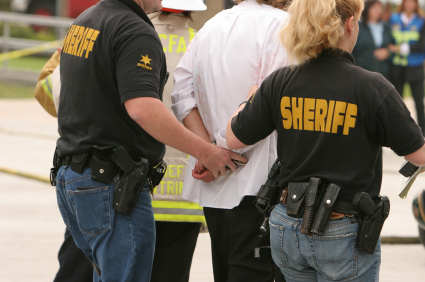
Sheriff’s Departments tend to be smaller than Police Departments. Typically, the Sheriff’s Department is responsible for enforcing the law on a county rather than city level (unless there is no city police, then it is responsible for city law enforcement as well). A Sheriff’s work is done both in and out of the office; patrolling the county and managing paperwork like warrants, complaints, and deputy patrol activity records are typical job duties. Those who would like to run for Sheriff should be at least 21 years old, have no felonies, and have a high school diploma or a GED. However, as in most law enforcement careers, education beyond a high school diploma or GED is always preferable and advantageous. To illustrate, a degree in Criminal Justice from an accredited college will get you much farther than a high school diploma.
As with other law enforcement positions, regardless of rank or department, good physical fitness is essential to the job. You may have to sit or stand for extended periods of time, lift moderately heavy objects or persons, search in confined areas (under dashboard, for example), and pursue suspects on foot. Vision and hearing must meet department standards (vision correction is acceptable). The ability to communicate effectively both verbally and in writing is imperative, and you are expected to possess basic math skills.
In brief, a Sheriff’s Deputy job description reads much like that of a Police Officer’s, with a few exceptions. Primarily, Sheriff’s Deputies provide security for the county court, often in the form of bailiffs. They also escort prisoners to and from the county jail, often working with the state corrections facility. They answer to the Sheriff and patrol the county.
General Job Duties of a Sheriff
- Supervises a force of deputies and other employees of the sheriff’s department
- Enforces the law on a county level
- Oversees the distribution of funds for undercover operations
- Acts as the county jail’s warden; accountable for the custody and care of prisoners
- Supervises operations of the county jail
- When County Courts are in session, acts as Chief Security Officer
- Review, as necessary, evidence, daily patrol activity logs, information on division activities, investigations, effectiveness of procedures, efficiency of subordinates, etc.
- Perform training sessions at police academy or other training facility
- Take field command in emergency situations
- Take disciplinary action for employees when necessary
- May conduct public information sessions on law enforcement matters
- Assists with personnel problems within division
- Develops procedures and guidelines for officers based on legal material and law enforcement experience
- Firearms training and operational preparedness
- Prepares budget
- Makes requests for services and equipment, justifies purchases as needed
Interview with Deputy Scott Steinle

Want to know what it’s really like to be a Deputy Sheriff in a major metropolitan area? Check out our interview with Deputy Scott Steinle of the Orange County Sheriffs Department.

Let’s start off easy, could you give a short history of your work as a deputy and why you chose to pursue a career in law enforcement?

I work as a patrol deputy for the OC Sheriff’s Department North Patrol Region. Before that I’ve worked as a jail deputy, a bailiff, and a recruitment officer. I wanted my career to be something that reached out and affected all areas of my life: to be physically and mentally active, help other people and something that was different everyday. Being a police officer seemed to be the best fit. . . . Read the full interview here.
Sheriff’s Department FAQs
What is the difference between a Sheriff and a Police Officer?
The difference between a Sheriff and a Police Officer is that a Sheriff is elected by voters and in some counties they are not required to have a law enforcement background. Also, a Sheriff is a higher ranking position and provides law enforcement within county level, whereas a Police Officer provides law enforcement within the city level. Police Officers answer to the Chief of Police while Deputies and Deputy Sheriffs answer to the County Sheriff.
What is the difference between a Sheriff and a Deputy?
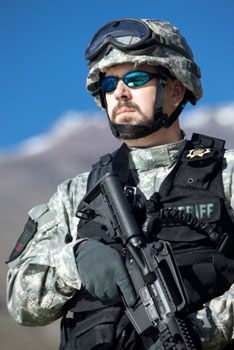
A Sheriff supervises his or her Deputies; Sheriff is a higher ranking, elected position and there is only one Sheriff to several Deputies. Deputies must have law enforcement training, whereas Sheriffs do not always have to have such training.
How do I become a Sheriff?
Because Sheriff is an elected office, you would first have to wait for an election year then campaign in the county you are interested in being Sheriff. The best way to prepare is obtain law enforcement training and education. Being in law enforcement already is a huge advantage when running for Sheriff, and in most cases it is required.
What level of education do I need to become a Sheriff?
Although most Sheriff’s education requirements list having a high school diploma or its equivalent, possessing an Associate’s or a Bachelor’s Degree in law enforcement is ideal.
What is the Jurisdiction of a Sheriff compared to a Police Officer?
A Sheriff’s Jurisdiction is countywide, whereas a Police Officer is citywide.